Off Broadway (and sometimes Broadway) Reviews and Information.

Showing posts with label 59e59. Show all posts

Friday, January 20, 2023

Heaven: Lost and Found in Ireland

There is a distinctive way many Irish theater productions play out, and your enjoyment of Heaven might depend on if you love, hate or are indifferent to that style. Heaven is a two hander, where the actors speak directly to the audience. Often, in Irish plays, one character talks to the audience for the entire show. But in this one, both characters talk one on one to the audience, albeit never at the same time.

The characters are a married couple, Mairead (May) and Mal. May is played by Janet Moran in a wistful but lovely turn. Mal is played by Andrew Bennett with more self-loathing and awakening but the same skill. They each describe their marriage and their feelings and questions to the audience. Both partners are separately challenged at the reception of a wedding they are attending.
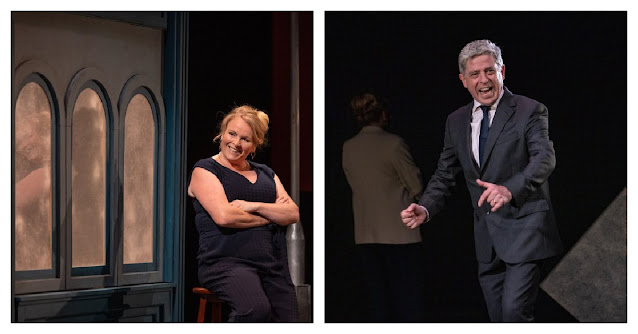

Janet Moran and Andrew Bennett in Heaven (photo: Ste Murray)

May discusses the rut her marriage is in, the bitterness of having a daughter that fights with her every time they talk, and the disappearing hope for the future. At the party, her assumptions about her complacent life are challenged by the return of an old beau. One with which she had fantastic sexual chemistry.

At the same party MAL, a sober alcoholic, reflects on his hidden sexuality, hidden even from himself in many cases.. A sexuality that manifests itself it some very interesting fantasies about Jesus freeing him from his repression. His internal struggles are deeply felt as are May’s.

The story uses the background of the wedding to illustrate May’s struggles. The story uses a background sexual frustration and then a man's inducements to have Mal to partake of liquor and cocaine to illustrate Mal’s struggles. Neither analogy is as heavy handed as it sounds. And both May and Mal build the tension slowly until it grows to consume them.

I enjoyed the show very much, despite my dislike of the format. Few shows handle this setup as well at Heaven – the last I saw done this well was A Steady Rain on Broadway with Hugh Jackman and Daniel Craig. Janet Moran and Andrew Bennet are not nearly as famous as that pair, but these two also inhabit their characters fully and believably.

Written by Eugene O’Brian and directed by Jim Culleton, the timing of the soliloquies and the passion of them is a credit to both. It is a simple set and design in order to bring the characters front and center with lighting and subtlety. I enjoyed it very much.

Heaven
Playwright: Eugene O’Brian | Director: Jim Culleton | Cast:

Wednesday, March 4, 2020

The Incredible Journey of Mr. Toole

You don’t have to read the Pulitzer Prize winning book A Confederacy of Dunces to have a great time at the show Mr. Toole. The show stands perfectly well on its on without reading Mr. Toole’s hilarious and Pulitzer Prize winning book. As a matter of fact, a remarkable amount of the story takes place after Mr. Toole himself leaves the scene. For a lover of the book, this is no surprise. A Confederacy of Dunces was published posthumously, and Mr. Toole tells the tale.

Ryan Spahn and Linda Purl in Mr. Toole
Ryan Spahn plays John Kennedy Toole- called Ken, returned from the army and teaching poetry at a girl’s college, while writing at night. He lives with his parents, his mother Thelma (Linda Purl in an epic turn) and his father John (well played by Stephen Schnetzer). Mother Thelma lives through her son in a possessive and suffocating manner. Ken is stuck at home, unable to afford leaving either financially or emotionally.

Ken is despondently alone, despite a gay love life and students that adore him. One young lady in particularly, Lisette (Julia Randall) has a crush on him and his writing that endures. He cannot break from his mother, even after Simon and Schuster show an interest in is novel. That interest results in two arduous years of rewrites that ultimately result in a final rejection which destroys him.

Thelma at a loss for purpose, then takes up the task of getting his novel published. Her single-minded determination destroys her marriage, her health and nearly her life. Her brother Arthur (Thomas G. Waites) saves her from a nursing home. But she is redeemed, in the end, by another writer, Walker Percy (John Ingle). Mr. Percy helps her to get the story published.

Mr. Toole is a wonderful experience, albeit not perfect. It is a little long, and the use of dual read poetry was superfluous for me. But these are minor issues in a show I adored. Playwright Vivian Neuwirth brings complex emotions to the fore and Director Cat Parker keeps the show moving briskly along.

Mr. Toole
Playwright: Vivian Neuwirth | Director: Cat Parker | Cast: Julia Randall, Ryan Spahn, Thomas G. Waites, Linda Purl, Stephen Schnetzer, John Ingle

Sunday, February 23, 2020

The Sabbath Girl Delights at 59E59

The Sabbath Girl, now at 59E59 theaters, is a wonderful little romantic comedy of a show.  It starts Lauren Annunziata as Angie, a together young lady with a desire able job at a gallery and a brand-new apartment. As she shows off the apartment to her grandmother, Angelina Fiordellisi, we can feel the happiness.

She is interrupted from setting up her place by a knock on the door. This introduces Seth, Jeremy Rische, her neighbor. Seth is looking for the old occupant, who would sometimes help him on the sabbath. And now we have the New York meet cute. Together young girl, in her first apartment without roommates, and shy, adorable Orthodox Jewish man who needs help. It doesn’t take a rocket scientist to see where this is going, but it is a sparkling journey none the less.

The Sabbath Girl with Lauren Annunziata and Ty Molbak

The complications are raised by Ty Molbak as Blake, a hot new artist Angie is trying to get at the gallery and Laura Singerman as Seth’s sister, Rachel. Ty is a great flirt, sexual and interesting, a far cry from the overbearing and obnoxious suitors in most rom-coms. It is great choice as we see Angie’s interest in this man grow.

Seth’s sister, Rachel, on the other hand, is a bit more formulaic. She does not approve of Seth’s attraction to a woman outside of their world and is not pleased. Rachel attributes Seth’s interest in Angie as a response to a bitter divorce and failing in his faith. Both obstacles are overcome in The Sabbath Girl that runs along quickly and well-paced. It is a smooth 85 minutes, but never feels rushed.

The older voice of sanity here is grandmother Nona, played by experienced performer Angelina Fiordellisi. Nona is Angie’s sounding board and confidante. She offers reasonable advice, a shoulder to lean on and is a constant reminder of the happiness real love can bring.

The Sabbath Girl was written by Cary Gitter and directed beautifully by Joe Brancato. If you are looking for a nice evening out, The Sabbath Girl is great. And, if you see it with someone you love, it is even better.

The Sabbath Girl
Playwright: Cary Gitter | Director: Joe Brancato | Cast: Lauren Annunziata, Angelina Fiordellisi, Ty Molbak, Jeremy Richse, Lauren Singerman

Wednesday, February 12, 2020

Aren't Roommates the Worst? - The Commons


There is a certain humor in The Commons that will appeal to many people. It is that type of mean spirited, uncomfortable humor that borders on bullying, but is okay since it is on stage because we know the characters aren’t real. Usually played out in family serio-comedies where the various family members can’t escape, like Thanksgiving or a will reading. In case of The Commons, it is four roommates who agree to spend a year together in the form of a New York lease.

The four roommates are older lease holder Robyn (Ben Newman), combustible exotic Janira (Olivia Khoshatefeh), mean girl Dee (Julia Greer) and loser Cliff (Ben Katz) - who is pathetic because he tries to be a nice guy. The relationship dynamics are developed and then hardened with the repetition of the dreaded roommate meeting. The meetings usually come down to this; something has bothered Dee and she will explain it. Then she will explain it four more times, as if to a slow child in a remedial class. Cliff will apologize and try to do better, but Dee has to keep complaining about it long after everyone has agreed with her.

l-r: Ben Katz, Ben Newman, Julia Greer in THE COMMONS at 59E59 Theaters. Photo by Carol Rosegg
 There is no making Dee happy. She complains that she lives in the loudest room but won’t change despite everyone’s offer. Dee can’t stand dirty dishes, even after someone else has done them. Dee values honesty, but actively makes fun of people behind their back. Cliff’s greatest character flaw is that he is a male and is trying to be pleasant. It is not clear if Dee hates all men, or just the two that live in the apartment with her, but she hates them both with a gusto unbounded.  But then again, she’s not wild about Janira either.

I am not sure if The Commons has a moral, besides don’t live in a communal situation. There was no character growth, Dee was just as mean as she moved out as she was during the majority of the show, and the other characters were still just as confused by it. The one person Dee did get along with was Cliff’s ex-girlfriend Anna (Olivia Abiassi), a presence that was introduced and swept away too quickly.

Playwright Lily Akerman has captured the dynamic of a horrible living situation, but I am not sure that the story tells us much. Director Emma Miller moves the pace along well, The Commons doesn’t feel rushed, and it does cover the year in 100 minutes. The sniping was too mean spirited for me to enjoy, but it will hit the spot for many audience members.

The Commons
Playwright: Lily Akerman | Director: Emma Miller | Cast: Ben Newman, Olivia Khoshatefeh, Julia Greer, Ban Katz, Olivia Abiassi

Tuesday, April 23, 2019

The Music Hall visits 59E59

At the 59 E 59 Theaters, a very funny throwback show is going on. Instructions for American Servicemen in Britain, is a Music Hall style review that travels from humorous to hilarious. The piece plays off a 1942 US Army pamphlet of the same name that tried to explain the British to American servicemen.

L-R: James Millard, Dan March in Instructions for American Servicemen in Britain. Photo by Lidia Crisafulli 
The audience is treated as a newly arrived squadron of Army Air Corps being briefed on the traditions of the British. The three man cast is excellent and also wrote the story: Dan March, James Millard and Matt Sheahan. They each play a main character and occasionally bring secondary characters to life.

The play doesn’t have an overarching theme, but plays off a series of vignettes that flow as information to the new troops. All are funny, but some are hilarious. Matt Sheahan’s explanation of the British monetary system in the forties - the time of shillings, pence and farthings - is confusing, impenetrable and wildly funny.

Dan March’s American Colonel is the epitome of a period of US bluster and self-importance. He is the ugly American that makes you laugh both with and at him.

James Millard plays a perfect American guide, trying to bridge the differences, keep the peace and move the training along, without offending either side. Mr. Millard also indulges in the odd British tradition of dressing up in female drag and acting with broad farcical effect. It is dated and silly, but still oddly charming and humorous. 

The audience loved the show, despite a wide range of ages. The three man troupe engages in a lot of audience banter. To their credit, they are able to work both when the audience joins in, and when they have a bunch of stiffs sitting there.

Instructions for American Servicemen in Britain is a slight and dated show, but somehow it works even better as a period piece. Today the jokes would be stereotypes and not funny, but here, taking the piss out of both sides, it is all obviously in good fun.

Instructions for American Servicemen in Britain
Director : John Walton / Playwrights & Cast: Dan March, James Millard, Matt Sheahan

Monday, March 18, 2019

Picking Up the Pieces in After


After is a gut punch that sneaks up on you. The play is set in an upscale house, typical of something you would see in Westchester or the Hamptons, smoothing blues and tasteful furniture. And it is populated by the nice mid-upper class semi-repressed white inhabitants you expect. The very normality is what lulls you into the expectation of a simple story with simple answers. Author Michael McKeever gives a straightforward, albeit not simple, story and then delivers the raw emotions that go with it.

The central dynamic of After is the conflict between two sets of parents who are long acquaintances, but not friends. Connie and Alan Beckman (Denise Cormier and Bill Phillips) are visiting the home of Julia and Tate Campbell (Mia Matthews and Michael Frederic). The Beckman’s son was bullied by the Campbell’s son and they have been invited over to discuss the situation. Julia Campbell has also invited her sister who is an old friend of Connie’s. Sister Val (Jolie Curtsinger) comes to the discussion as a referee of sorts.

Mia Matthews, Jolie Curtsinger, Bill Phillips, Denise Cormier, Michael Frederic in AFTER at 59E59 Theaters. Photo by John Quilty Photography
What follows is a series of three scenes, each dealing with more complexity from the original incident. The emotions drive into and then past the stereotypes of the characters. Denise Cormier is an over-protective mother of a sensitive son. Bill Phillips plays her husband as a beta male, a man who just lost his job in the cut-throat world of finance. In contrast, the Campbells are the power couple. Mia Matthews is the perfect housewife and mother, perfect to the point of obsession. Michael Fredric is her husband, an alpha male who sees anything less that outright injury as boys being boys as they become men.

Jolie Curtsinger is the woman in the middle. She is Julia’s sister, but an old friend of Connie. She exists to give us voice and insight into these people who, left to their own devices, would simply bluster and leave. She is the catalyst that moves them past their own viewpoints. It sounds a bit forced, but in practice it is an organic element that greatly benefits After.

I don’t want to say too much about the plot because After should be a bit of a surprise for the full  effect, even when it feels a bit predictable. But rest assured, the performances are uniformly flawless. Michael Frederic can never drop his alpha demeanor and yet he still brings a depth to the performance that is shocking. And the transformation of Mia Matthews as the perfect housewife is harrowing. By contrast the transformation of Denise Cormier and Bill Phillips seem at first a shorter journey. But the depth they bring to the characters is wonderful. And Jolie Curtsinger never feels anything but critical to the action.

I loved After. I was surprised and touched by this show. It is a bit of a throwback to peal at the emotions of an upper middleclass privileged family but in using these characters the commonality of emotions is explored. It is wonderfully directed by Joe Brancato allowing his actors freedom to feel, and never letting it feel over the top.

After
Playwright:Michael McKeever | Director: Joe Brancato | Cast: Mai Matthews, Bill Phillips, Denise Cormier, Jolie Curtsinger, Michael Frederic
-->

Tuesday, February 12, 2019

The Waiting Game Brings a Bit of the Fringe to New York


The Waiting Game now at 59 E 59 Theater is direct from an award-winning run at the Edinburgh Fringe Festival as Best Overseas Play. It is very much a Fringe play in that it is quickly paced, intelligent and demands a bit from an audience. When given its due, The Waiting Game is a rewarding and excellent piece of theater.


The Waiting Game explores how we hold on to people and experiences, and how we must proactively act to let them go. The story revolves around Paulo (a terrific Marc Sinoway). Paulo’s husband, Sam, lies in a coma in the hospital, brain dead, but his heart still beating a year after an overdose. Paulo is in a relationship of sorts with Tyler (Julian Joseph in a heartbreaking role). Tyler provides Paulo with companionship and sex while demanding very little in return. Paulo has trouble supplying even the little emotional support Tyler needs.


L-R: Marc Sinoway, Joshua Bouchard in THE WAITING GAME. Photo by Carol Rosegg

Paulo also must deal with Geoff (Joshua Bouchard), who was in a healthy relationship with Sam for at least a year before the overdose. Geoff believes that Sam was ready to leave Paulo and live with him, had the accidental overdose not occurred. Paulo resents the idea of Geoff much more than the reality of Geoff.  Geoff entered Paulo and Sam’s marriage as a sex partner, which was acceptable, but Sam and Geoff’s relationship grew, which was outside of the bounds of the agreement. Had Paulo and Sam’s relationship been healthy, the Geoff / Sam relationship would never have grown. As it is, Paulo resents Geoff, but doesn’t deny his importance in Sam’s world.

After waiting for Sam to leave Paulo, now Geoff is waiting for Paulo to let Sam go. Joshua Bouchard does a great job with the role of Geoff, who is sometimes very sympathetic and sometimes not sympathetic at all. On the other hand, Paulo is actively not sympathetic. Self-centered and callous, Paulo has channeled his hurt and confusion into anger and manipulativeness. He forces Tyler and Sam to jump through hoops, while offering very little in return.

The Waiting Game is not an easy play to love, as the pieces don’t fall neatly into place. It suggests emotions and forces the viewer to supply motivation. Why has Paulo retreated into himself? Is the casual drug use a symptom of Paulo’s pain, or was it the cause of Sam’s pain? Why is he such a dick to everyone? Having said that, I did love the show. I found the contradictions honest and raw.

Playwright Charles Gershman has crafted a unique vision at the crossroads of drug use, sex, marriage and HIV status. Nathan Wright has staged it interestingly and pulled out wonderful performances from the actors. It could have used a bit more dialog and a little less distracting stage business, that is where I think the straight transition from the Fringe environment hurts the result. But those are minor nits which are lost in the unique voice The Waiting Game brings.

The Waiting Game | Playwright: Charles Gershman | Director: Nathan Wright | Cast: Joshua Bouchard, Julian Joseph, Ibsen Santos, Marc Sinoway | website


Friday, July 20, 2018

Edward Gero Brings Scalia to Life in The Originalist


The Originalist has a lot to say about the Constitution, the Supreme Court and our country’s inability to discuss politics and find a middle ground. In this, it is more relevant now that it was when written in 2015. It is also a bit harder to watch now than in 2015.

Edward Gero inhabits the role of Judge Antonin Scalia, and brings him to life with vitality, humor and panache. Scalia loudly believes in ruling from the court on the original intent of the authors of the constitution, not any interpretation. Mr. Gero sells Mr. Scalia’s ideals with forcefulness and self-assurance and deals with liberals with contempt. Like the real Justice Scalia, he invites a liberal into his den, but only one smart enough to engage with him.

Tracy Ifeachor plays Cat, the liberal law clerk that becomes sparring partner, sounding board and, ultimately, friend. Ms. Ifeachor does a great job with the part, challenging the Justice enough to work with him, but not enough to truly offend him. This is not the dramatic stretch it might seem; Justice Scalia did often employ one liberal clerk on his team.

L-R: Edward Gero and Tracy Ifeachor in  THE ORIGINALIST. Photo by Joan Marcus
 
In the course of The Originalist, Scalia and Cat banter back and forth, the conservative judge and the liberal clerk. If they don’t always find a middle ground, and they rarely do, at least they are honest enough to listen to each other and understand their viewpoints. Throughout Cat’s year with the Judge, she proves her intellectual value repeatedly.

But there is a problem with The Originalist, and it is that the world has changed in ways that were unexpected. Justice Scalia was often on the wrong side of very close decisions and the play gives him a voice, trying to explain to future audiences what motivated this man and what made him tick. Yet less than one year later Justice Scalia passed away. His replacement was appointed by President Obama, whom Scalia hated, but that man was never confirmed or even interviewed. Rather the seat was stolen and given to another believer in original intent. Throw-away comments that would be funny if history proceeded according to precedence, are now arrows at the heart of our system.

Edward Gero’s irascible Justice Scalia was endearing because he was the last stand of an embittered, privileged group of angry white men. Now that he isn’t the last stand, but perhaps at the forefront of the next few decades, the show isn’t nearly as funny. In trying to find a middle ground, Scalia mocks Cat as lacking the killer instinct which will doom liberals. She notes back that history is on her side. It turns out Justice Scalia was right.

The cast here is fantastic, both Mr. Gero and Miss Ifeachor are brilliant. Brett Mack, in a small role, was so perfectly loathsome I wanted to smack him from his entrance in annoying preppy boots. Author John Strand gives us a wonderful play that strives to make the point that we need to value the opinion of the other side, and Director Molly Smith brings it to life on stage. Unfortunately for the country, they are signing (Opera) to the choir.

The Originalist | Author: John Strand | Director: Molly Smith | Cast: Edward Gero, Tracy Ifeachor, Brett Mack | website

Friday, September 1, 2017

Heady Humor Files in Charolais


Charolais is a rare thing, a whip-smart play masquerading a simple story. Sweetly written and performed by Noni Stapleton, Charolais is the tale of a love triangle – or maybe more than one triangle.
Noni Stapleton plays Siobhan, a big hearted Irish lass who is employed to help with the administrative side of a family farm. The farm is run by a strapping son and his embittered mother. Siobhan falls for the son, Jimmy, after watching him wrangle a cow out of a muddy field. And, oh, how she would like to be that cow... wrapped in Jimmy’s strong arms being gently rocked back and forth until free.
Noni Stapleton in CHAROLAIS at 59E59 Theaters. Photo by Hunter Canning
 Jimmy and Siobhan, thrown together in work, are soon enough together in the biblical sense as well. And, good Irish folk that they are, not long after Siobhan is with child, albeit without husband. Yet. Siobhan imagines a future of happy farm family, but two things stand in her way. The most formidable is Jimmy’s mother. Jimmy’s mum is not generally receptive to Siobhan in the best of times, and Jimmy is worried how she will react to Siobhan’s news.
Less obviously formidable, but with a greater hold on Jimmy’s heart is the beautiful Charolais cow. Jimmy has a devotion to that cow that frustrates and later infuriates Siobhan. It is a nearly unbreakable bond, so what is Siobhan supposed to do?
Telling more might ruin the story of Charolais, and the story is pitch perfect with a few surprises left. How much of this terrific play and pacing is director / developer Bairbre Ni Chaoimh’s work and how much is Noni Stapleton’s is hard to judge. But it is easy to judge that the final project is impressive in humor, scope and heart .
Charolais | Playwright: Noni Stapleton | Director: Baribre Ni Chaoimh | Cast: Noni Stapleton |website

Wednesday, July 5, 2017

Interviews with the Actors of Dickless (this month 59E59 and in August in Edinburgh Fringe)

The Road to Edinburgh for Dickless – Part 1
Last summer I watched a few plays being read at Mass Rhetoric, a showcase put on by the Fundamental Theater Project (link). One of those show in the early stages was Dickless, being performed by Lauren Downie and Tessa Fairey. I was impressed with the play and the players and so I was pleased to see that the Fundamental Theater Project is taking Dickless to the Edinburgh Fringe Festival and showing it at 59E59 before it heads out.
Last week I sat down with Lauren Downie and Tessa Fairey, along with playwright Aisha Josiah, Director Jamie Sims and FTP Artistic Director Sam Underwood. We discussed Dickless, the process of creating the show and the road to Edinburgh. The interviews are not word for word here, but based on my recollection and summary.

What brought you to this piece originally?
Tessa Fairy: It is a pretty universal piece and a highly emotional journey by the characters. These characters represent the experiences we have all had.
Lauren Downie: When I do the piece, it is easy for me to use my own Scottish background, because I know people like these characters. People that are struggling and going through their problems.
TF: It’s the same for me. These characters can be found in England or Scotland or the US.
Aisha, did you do that purposely?
Aisha Josiah: No. (laughter) I mean I knew it was going to happen, but I wrote Dickless from my perspective. My mother is English and my father is American, so I never felt fully part of either culture. I am have always felt a little “different” from my peers and that comes through. And everyone, at some point, feels different. So that experience is universal.

From my perspective, the format of the play is very British. That is, a character talking to the audience; and not just talking to the audience like a one person play, but telling a story.
AJ: I never really thought of it that way, but my background is partially British, so maybe that’s it. And people have said my writing is more poetic than some of my American peers. I’m not sure that is a good thing.
Sam Underwood: Part of it, the British part, is a joy of language and story-telling. I think it goes back at least to Shakespeare, you see that we love telling a story, even when it is told by a single person.
Jamie Sims: Part of it is also the dynamics of the English system. We still have an active radio drama outlet in the BBC.
LD: You can see that a lot of the actors have done BBC radio dramas – where the voice inflection is the tool you have to use. So we are more comfortable using the format.
TF: And, from an acting point of view, it can be very powerful. The 59 E 59 theaters just put on Iphigenia in Splot and the audience reaction was excellent. (Note: Iphigenia in Splot was part of 59E59 theaters “Brits Off Broadway” program this year.)
LD: The audience and reception was great. Even though there were some idioms and jokes that the US audiences might have missed, the emotion came through and people loved it.
Lauren Downie and Tessa Fairey
Have you made a lot of changes since it was in your Mass Rhetoric show?
TF: Not a lot of changes. The biggest, of course, is that Lauren and I are alternating nights now instead of alternating halves with the character shift. That has required some rethinking to get our own voice.
LD: When we did the show first, we each started with a character. Even later when we shifted characters, you can’t help maintaining the choices the other actress did. I ended up doing the character of Saff in the same way that Tessa did. And she did the character of The Oli the same way I did, because I did it first.

So has that change be tough?
TF: It has a bit. It means that I have to find this person all over again. Jamie has been great with that. He has pushed me and Lauren to really give find that second character of our own.
LD: Jamie has been great doing that. And he came in late to the process, but he came right up to speed.

In part two, we will look at the change in directors, what the FTP has in mind for Edinburgh and the decision to showcase the play in New York before it head to Edinburgh.

tickets

Wednesday, June 14, 2017

Invincible Never Lets up on Laughs or Poignancy


Invincible is a story that explores our views and expectations of others in the current political dynamic. Amazingly, Invincible does this with a large dose of humor, running from oddly quaint and British to dark humor that is jet black. And the four excellent actors deliver the show with honesty and surprising clarity.
Invincible tells the story of middle class couple Oliver and Emily, a British version of Yuppies, but who are hit by economic forces and move to the North of England to save money. Alastair Whatley is the rather put upon Oliver, trying to juggle the new location along with Emily’s fragile mood swings, two children and a lack of funds. Emily (Emily Bowker) is a nervous, strident old school Laborite, who still spouts Marx when she isn’t berating the downfall of the world, based on whatever floats into her view. Emily is that horrible person at a party who still believes everything she heard in university and insists on sharing her views with you. Onstage, Emily is funny and awful, in person Emily would be insufferable.
LtoR Emily Bowker, Graeme Brookes, Elizabeth Boag and Alastair Whatley in Invincible (photo:
Trying to fit in to the block, they invite the next-door neighbors over, Dawn and Alan. Elizabeth Boag and Graeme Brookes bring a loveable quality of terrifying honesty to this funny working class couple. Dawn finds Oliver and Emily posh, but confusing. Alan shows up post-soccer match with a can of beer and insanely high spirits. The culture clash is inventible and hilarious. The British markers for class are copious and broad: cricket versus football, esoteric music, distain for sports patriotism, public versus neighborhood schools, the list is long and Invincible references many of them.
But, slowly and slyly, Invincible changes the focus from easy jokes to human interaction. Not the assumed “we’re all the same underneath”, but a more difficult and painful truth that maybe we grown so far apart economically and socially that we it is almost impossible to connect. In the US, this divide runs politically, but a similar divide indeed.
The second act of Invincible is touching and funny, but I don’t want to give anything away, so I won’t. I will say it is beautifully directed by Stephen Darcy, who varies the pace of the show effortlessly. Torben Betts writing rings true to me, but I haven’t lived in England in 30 years, so other would know better than I. Invincible is a hugely enjoyable play that doesn’t skimp on story, laughs or a proper ending.
Invincible | Playwright: Torben Betts | Director: Stephen Darcy | Cast: Elizabeth Boag, Emily Bowker, Graeme Brooks, Alastair Whatley | website

Sunday, May 14, 2017

Rage as Entertainment


Sophie Melville is transfixing as Effie in Iphigenia in Splott. Splott, in case you don’t know, is a depressed suburb of Cardiff, the city in Wales. Iphigenia, Effie as she is called by everyone, is an unemployed, unhappy, listless young adult with few prospects going forward. She is also hard, crass, bitter and nasty to everyone from her boyfriend to strangers on the street. On the positive side, she enjoys being a bitch.

Sophie Melville in Iphigenia In Splott. Photo by Mark Douet.jpg

Her rage is transfixing and often humorous, albeit exhausting, as she berates anything or anyone that wanders into her zone of attention. Effie’s weekly routine consists of drinking, screwing and dealing with a hang over until she is ready to do it all again.
Iphigenia in Splott takes this character and listens as Effie tells the story of when her life changed, when she realized there was more possible. It is a format of a play that is often used in single character shows, particularly British or Irish pieces. Her story revolves around a man she met at a bar that might or might be her soulmate and what happens to her after that meeting. It isn’t a harrowing tale, but it is a heartbreaking story. There is a bit of social rage tacked on at the end that tries to make the audience think twice about the plight of people like Effie in towns like Splott.
The play is effective and the audience connects with Ms. Melville. She gives a great performance, but it is a performance limited by the format. The audience listens to Effie rage and pout and swagger about for 80 minutes. It is a long time to spend with a, mainly, unpleasant and inconsiderate bitch, even if you feel for her. A strong Welsh accent doesn’t help matters, and makes it tough to keep up, particularly when her volume launches into a screech.
Directed by Rachel O’Riordan, Iphigenia in Splott forces you to care for Effie, ultimately excusing her actions and attitude because of luck and forces well beyond her ability to control. In this, Iphiginia comes from a very European mind-set where your opportunities are predetermined, children pay for the crimes of their parents and you have very little control over your fate. If you believe that, then rage might be the only reasonable response.
Iphigenia in Splott | Playwright: Gary Owen | Director: Rachel O’Riordan | Cast: Sophie Melville | website

Tuesday, May 2, 2017

History, Heartbreak and Humor Mix Wildly in Fossils

-->
Fossils dances to on stage at the 59E59, as part of their Brits Off Broadway series. It brings a decidedly off-beat and British sense of humor and resoluteness that sparkles wonderfully in the dark. Fossils was written by Bucket Club - who want to explore how stories are told by changing the dynamics of the play going experience and, in this show, using live music in profoundly new ways.  
Fossils is the story of Vanessa, a research fellow in evolutionary biology. She is focused looking at the changes over time of long lost life forms, how they evolved and what happened to them. Vanessa is equally determined to not look at her own history, with one missing parent and one parent she keeps at arm’s length. Vanessa also overseas two doctoral students, Dominic and Myles. Since she is slightly older and a much more rigidly structured person, they overcompensate by acting even younger and more irresponsible than they are.
L-R: Adam Farrell, Helen Vinten, and Luke Murphy in FOSSILS at 59E59 Theaters. Photo by Carol Rosegg
Vanessa and the teams’ routine is upset by a tabloid announcement, of a new siting of the Loch Ness monster. Because of Vanessa’s knowledge in the subject area, she is besieged by questions from the press. Questions she finds superfluous and distracting. But the questions also nag at her.
Ultimately, she and Dominic enter into a road trip to Loch Ness to find the answers of the mysteries of the monster and of her youth, include the disappearance of her father. 
The entire show is augmented by a plethora of odd musical accompaniment, more akin to an neo-electronic version of old radio musical effects than a score, by done purposefully and wonderfully. The effect is hypnotizing and beautiful and occasionally annoying - all at the same time. The music deepened the effect of the show rather than simply providing accompaniment.
Helen Vinten brings Vanessa slowly to life. Vanessa is a young lady who refuses to let anyone in emotional, as she must to thrive. Adam Farrell and Luke Murphy bring the two young research assistants to life with staggering realism for such an oddly surrealistic play. In the later portions of the show, Adam Farrell handles more the acting and Luke Murphy handles more of the music, but both shine through equally.
Writing company Bucket Club accomplish quite a bit in Fossils. The show gains complexity, layering and emotional depth as the evening progresses. Director Nel Crouch handles the entire group with a quiet restraint, which is necessary to prevent the show from running into full on comedy. It has a very British sense of humor, dry and uncomfortable at times but always intelligent and thoughtful. With Fossils, 59E59 has a truly unusal gem on their hands (sorry - horrible pun).
Fossils | Playwright: Bucket Club | Director: Nell Crouch | Cast:  Helen Vinten, Adam Farrell, Luke Murphy | website

Tuesday, March 14, 2017

Electrifying White Guy On The Bus Will Stay With You Long After You Leave


Robert Cuccioli and Danielle Leneé
There are some unsettling arguments in the first third of Bruce Graham’s terrific and powerful play, White Guy On The Bus. The arguments are unsettling for everyone on stage and most of us in the audience in that - are-WE-allowed to say that? - kind of way. But these questions are ultimately important because they go to the root of this incisive play.
Roz and Ray are a well off suburban white couple living in the suburbs of Philadelphia. Ray is a financial numbers guy, ready to move to the next phase of life; maybe retirement, but definitely spending more quality time with his wife. Roz is perfectly content with their current life, lifestyle and work. She is a teacher in an urban, primarily poor, black high school. They are joined for drinks one night by Christopher and Molly, a younger couple. Christopher is the young man who was raised next door and views Ray and Roz as surrogate parents. Molly is his new wife, a teacher at an all girls, very rich private school.
The discussions in question revolve around Roz and Molly’s ideas towards minorities, the opportunities they have and the choices we all make. Roz is smart but unyielding, and delivers damning accusations under the banner of “telling it like it is.” Molly is a modern liberal who tries to defend her ideals against Roz’ real world experiences. The reason this argument is difficult to watch is that these are two white women of privilege, who both acknowledge it, and both make excellent arguments. 
The discussions they have is one that “nice” people don't have in public. This is make doubly clear by the efforts the men make to turn the conversation to other topics. What makes it even more angst producing, is that Roz is a better debater, more experienced and yet makes the more racially based points. The audience wants her to be wrong, even as you know she reaches out to change the world for the better more than we do or Molly can.
L-R: Susan McKey, Jessica Bedford, Robert Cuccioli and Jonathan Silver in WHITE GUY ON THE BUS. Photo by Matt Urban/Mobius New Media Inc.
A concurrent story plays out with Ray, the numbers guy, riding a bus and starting a conversation and ultimately a friendship with a young black woman, Shatique. Ray is the White Guy On The Bus and Shatique is a single mother, attending nursing school to better her life. In the meantime, Shaitque's son lives with her own mother in a better neighborhood with a better school district until she finishes school.
Saying how these worlds intersect would give too much away. However, it is fair to say they don’t collide as expected, but meld like two spotlights ultimately ending up on the same target.
The acting here is fantastic. As Ray, Robert Cuccioli brings subtlety, passion and quiet depth to his role. Shatique is play by Danielle Leneé with a minimum of stereotyping and makes every moment feel real. Susan McKey plays Roz, perhaps the hardest role. Roz is a great teacher and is dedicated to her students, but still can be a harsh and prickly debater. Ms. McKey pulls this off well, with a huge hat tip to playwright Bruce Graham’s work. Jessica Bradford and Jonathan Silver do fine work as the younger couple Molly and Christopher, but their characters take a more obvious arc.
Director Bud Martin does a wonderful job with these actors, this delicate story and minimal staging. Keeping the pieces separate but intersecting is not easy, but he handles it with precision and aplomb. White Guy on The Bus is definitely worth the trip to 59 E 59 theaters. I promise it will stay with you long after you leave.
White Guy On The Bus | Playwright: Bruce Graham | Director: Bud Martin | Cast: Robert Cuccioli, Jessica Bedford, Danielle Leneé, Susan McKey, Jonathan Silver

Wednesday, October 9, 2013

2.0 Brings a Updated View to Life

TWO_POINT_OH now playing at 59E59 theaters is a fascinating new play.  It is based on a futuristic premise, but addresses the current problem people have trying to connect with each other.  Science Fiction is one of the hardest genres to do well in the theater, but TWO_POINT_OH handles it beautifully.  Much of the credit has to go to the cast and creative crew that bring a future both immediate and believable.

Jack Noseworthy (on screen) and Karron Graves in
 TWO POINT OH at 59E59 Theaters. Photo by  Jimmi Kilduff
The story follows software billionaire, Elliot Leeds, and what happens after he dies.  His plane goes down, but Elliot has left a unique software program behind.  He has left a virtual reality version of himself embedded in the computer, to interact with his wife Melanie.  In a super wired mansion (ala Bill Gates’ home), this Elliot 2.0 can appear on-screen, tracking his wife’s words, movements and physical changes.  Always pre-occupied when alive, Elliot 2.0 has time to be the (almost) perfect husband.

Jack Noseworthy does an outstanding job, bringing this Elliot to life, solely via big screen.  The program’s “humanity” develops at a believable pace, transition as the program learns.  It is a rather thankless role, playing a computer simulation, but Mr. Noseworthy does it excellently.  Elliot 2.0 comes to understand his shortcomings as a husband and tries to correct them.  He also appears to his old partner, Ben Robbins.

James Ludwig plays Ben and shows us fully rounded individual.  Ben is neither all saint nor all sinner.   Ben was Elliot’s computer geniuses partner at the founding of the company, and he refuses to interact with Elliot 2.0 as anything other than a complex program.  Albeit a program that is both pushy and needy.

Karron Graves has a much more difficult time with the role of Melanie Leeds, the widow first, and then manipulated wife.  Ms. Groves does an excellent job with grief, too excellent.  The character of Melanie runs the full gamut of emotions, from love to annoyance to despair to incredulity.  And while Ms. Graves pulls each off wonderfully, the swings do pull the tone of TWO_POINT_OH abruptly.

L-R: James Ludwig and Antoinette LaVecchia in
TWO POINT OH at 59E59 Theaters. Photo by  Jimmi Kilduff
Both Antoinette LaVecchia, as the new company’s CEO, and Michael Sean McGuinness, as a sensationalist newscaster, provide some great laughs in a believable way.  Ms. LaVecchia in particular grabs hold of her role and plays it as wildly as possible, without going over the top.

As version 2.0, Elliot can finally see how technology, now making his “life” possible, interfered with his physical marriage before his death.  For us, there is no second chance, and the moral of the story is that delaying your real life for the vibrating phone or the immediate facebook post is rarely a good trade.  TWO_POINT_OH makes the point subtly, but elegantly.

David Bengali does a great job with the media/projection design, leaving the audience to question what was done live and what was pre-filmed.  Credit also goes to Mr. Noseworthy here; some in the audience wondered if he was actually performing (and were pleasantly relieved at the curtain call).  Done poorly, this design could have sabotaged the show, but Mr. Bengali does a stand out job of using the technology without letting it overwhelming the show.

TWO_POINT_OH’s tough stretch is rather early in the first half when Melanie has a breakdown over her husband’s death and then deals with his “return”.  Once we are past that writer Jeffrey Jackson and director Michael Unger can let the piece open up and take flight.
-----------------------------------
TWO_POINT_OH
Playwright: Jeffrey Jackson
Director: Michael Unger
Cast: Jack Noseworhty, Karron Graves, James Ludwig, Antoinette LaVecchia, Micahel Sean McGuinness